
This is the question: wither ’tis nobler in the minds of car enthusiasts to use a third pedal (clutch) or not. This is a matter for debate. Apologies to William Shakespeare, but for old car guys can any question be more important than choosing the right transmission for your build?
I’ve been part of many street rod builds and have experience with a range of transmission options. The well-rehearsed mantra, “a true hot rod has three pedals” is still heard but seldom heeded. My last street rod was a 1938 Ford. I built it with a manual three-speed transmission. I learned a lesson.
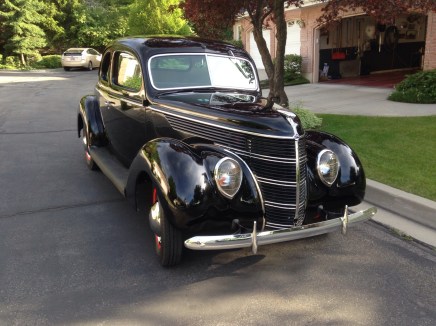
It was a gorgeous black coupe with a little Chevy 283 V8 engine. The car was very original and I decided to keep the manual three speed transmission—three pedals. Some would argue that when the driver can shift the transmission, he has more feel for the car. When the transmission is in the proper gear to match the torque range of the engine, acceleration is instantaneous and controlled. By downshifting, the driver can also use the compression of the engine to help slow down the car.
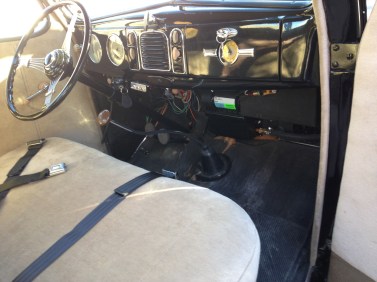
The good part was that it indeed had three pedals and the transmission was genuine Ford although a rebuilt 39 model with truck gears and open drive line. It looked good. However, from a performance point of view, it left a lot to be desired and was probably the weak link in the entire vehicle.

And that is after considerable expense and effort. It was noisy, the synchronizers were terrible, shifting was slow and notchy. The clutch was hard to adjust and the clutch pedal not adjustable and poorly positioned. Was some of this my fault? Yes, to be sure. But not all. We could have had a modern five speed manual transmission and in retrospect it would have been a better idea. Oh well. Live and learn.
When it comes to installing the right transmission, the decision to use either a manual or an automatic trans depends on your intended use for that vehicle. If you are a purist and drive a hot Cobra, then a four-speed manual transmission is a tradition. There are no rules as to what the correct application is. If you drive much in modern urban traffic, you might grow tired of shifting. I think I fall in that category.
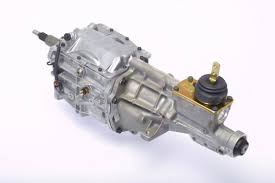
There are advantages of running a manual transmission over an automatic. For one, automatic transmissions tend to be physically larger. This can rob valuable real estate in the relatively tight confines of most street rods. Automatic transmissions also tend to generate more heat, and therefore need to be cooled by external means. This usually equates to either running a transmission cooler incorporated into the radiator, or running a separate tranny cooler (which takes up even more space). Additional drawbacks to running an automatic transmission are that most need a kick-down cable of some sort attached to the carburetor or throttle body, a vacuum line connected to the intake manifold, a dipstick, and of course, the shift linkage. In a tightly packed car such as a ’35 Dodge pickup, all these small items can quickly add up.

The advantages of a properly built automatic transmission in a hot rod application are also numerous. Nothing will be as consistent or as strong as a properly built automatic and complementing torque converter.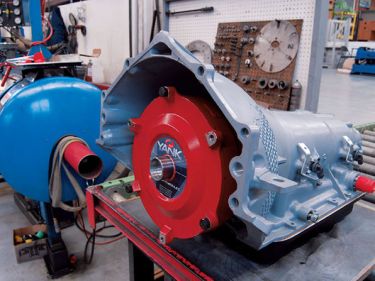
A properly built automatic will accelerate slightly faster than will an identically outfitted manual vehicle.
On the street, auto gearboxes greatly increase the drivability and “fun-factor” for the hot rod enthusiast. No more traffic jams spent with the clutch halfway engaged.
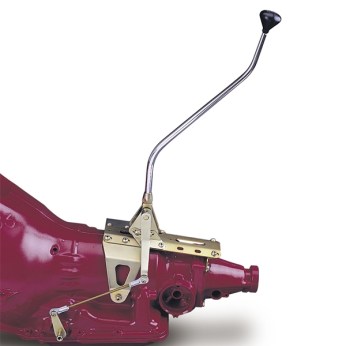
Transmissions, even automatic ones, need to be shifted. And for that, a shifter is required.Fortunately there numerous aftermarket folks who have supplied enthusiasts with a range of options. Some, like this floor shifter from Lokar, mimic the design an feel of the original manual transmission shifter.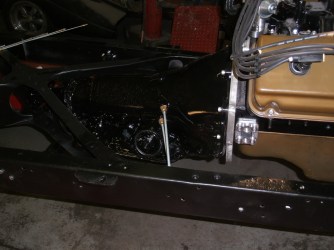
Finally you may wonder how an old Dodge hemi engine can be mated to a GM automatic transmission. This combination never occurred through the typical factory design process. But it is quite easily accomplished today by using appropriate adapters provided for this very purpose.

Equally clever is the shifter mechanism we’ve used. After an initial debate about how far to push an “aircraft” theme, we decided to use a time-test Lokar “double bend” floor shifter as shown above in the company’s advertisement. Ours has a slightly different bend configuration to better suit the needs of the small cab environment. These shifters employ a integrated button in the knob that when pushed down allows the transmission to be placed in reverse gear.
 Don Holsinger--an old guy's street rod
This car is mind blowing. The best car part which I liked is its car headlights. It appears as if it is someones eyes in real. Black color is my favorite when it comes to car.
Great Blog 🙂
LikeLike