
Just like death and taxes are the only two sure things in life, rust and hidden damage are the only two sure things in vintage project cars. No one wants to admit it, and it’s a bummer, but we all have to address them at some point in the build. We’re at that point now with the 1935 Dodge pickup project in Ephraim, Utah under the expert hands of my friend and master hot rod builder, Ralph.
Luckily the Dodge was originally a Colorado truck, a dry part of the country. Not as good as a southern California provenance (car speak for the car’s history) but in Colorado, Utah, Nevada and Utah, cars that sit out in the open air are comparatively free of consuming rust. Covered by surface rust, yes, but only the metal bits that are next to constant dampness suffer cancer destroying rust. That’s how the theory goes, anyway.
Fortunately, throughout our build progress so far, we uncovered patches of rust in just a few of the usual places for pickups, the lower part of the cab where water from the bed would have leaded and the bed itself and the cab corners. I’ll have more to say about the bed later but basically it was useless. The working end of the little Dodge had given its last full measure of effort—and we discarded it. However, to its credit, we had a new bed made at a shop near St. George, Utah in brand new, high quality steel.
Pickup beds are formed mostly by flat panels and are therefore easily and inexpensively reproduced. By contrast the rear fenders of the pickup, which we also discarded and new, were procured in beautifully sculpted steel. Fenders of vintage street rods have many curves and are difficult to reproduce and comparatively expensive. Like the fenders the curved sheetmetal was originally formed at the factory by massive presses that stamped the steel in the form designed. A few cabs are reproduced these days but not for the Dodge.
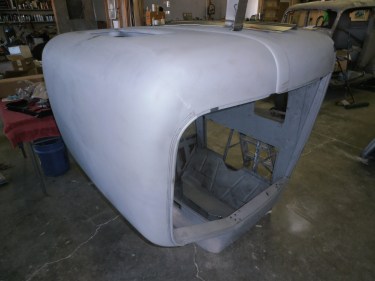
To expose all of damage to the cab from rust and crashes, Ralph turned his sand blaster on the cab, inside, outside, bottom and every which way. The best thing about sand (or media) blasting is that it uncovers the true condition of sheetmetal. That’s also the worst thing about media blasting.
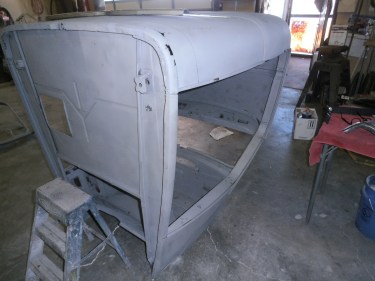
Photos here show the cab after Ralph’s thorough sandblasting session. All sorts of things are revealed. It’s now clean, bare, old metal and will rust again quickly if not treated with rust inhibitors. While still a very solid body, Ralph did uncover several spots of rust that needed a true bodyman’s touch.
This is where patch panels or rust repair panels come in. The ones we needed were available on eBay Motors. I purchased them believing the seller that they were indeed for a 1935 Dodge pickup cab.
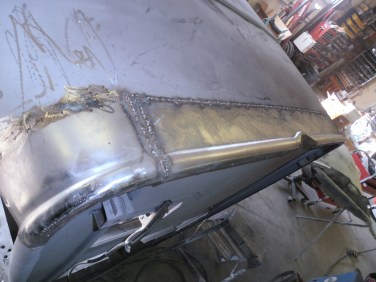
Ralph had the repair panels at his shop for a long time before he actually needed them. But it was only when he dug them out for panel repair that he discovered that they weren’t quite true to the intended application and required a good deal of metal working artistry before he could weld them in place.. So while the grafting in of pre-made patches makes this job a bit easier, it still takes experience, proper equipment, and honestly a bit of artistry to create truly excellent custom body patch panels. Thankfully I have long since found exactly the right guy to help make the old Dodge look like it had never known rust.
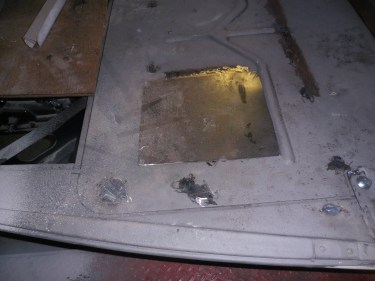 Some holes are filled in, usually because of metal rot, but sometimes because a change will be made and to make everything fit just rust, some basic changes in the body or sheet metal have to be made.
Here is an example of a new hole or a reshaped hole. The truck’s battery goes under the driver’s seat. Pretty darn hard to get to it but for number of reasons we decided keep modern 12V Optima batter in approximately the same position.
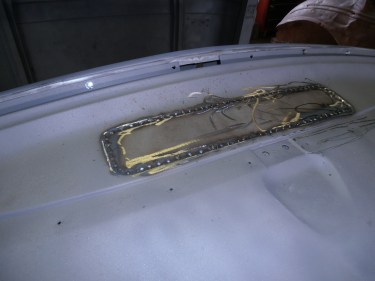
However, we it came to the old air vent, a different decision was made. I think these old mechanically opened and shut vent doors were ingenious. I like the look of them and I enjoy the fantastic volume of air that flows through them on a hot day. But our issue is different. Since this old truck will be sporting a modern air conditioning and heating system, there wouldn’t be much point to opening that vent. But the biggest problem with the air vent was in what lay below the surface–the mechanical bits cleverly engineered to open shut the vent from inside. That piece of real estate located directly behind the dash is heavily disputed. It will be a miracle if we can find a place for everything.
 Don Holsinger--an old guy's street rod
I like this blog! I like old cars so it is interesting what it is taking to make it like new! Will be fun to see the finish work.
LikeLike