
One of the many facets of building a hot rod is the creation of an exhaust system. Though header design is often left to professionals (the meticulous work and time required to make a great set of engine headers is cost-prohibitive), I plan to use a good set of cast iron headers. They look good, won’t corrode or discolor easily and will make a good sound and contribute to reasonable power output. The rest of the system will be assembled and finished by Ralph who has decent welding skills, a good selection of tools, and plenty of prior experience.
Designing the system and then gathering the right parts were the first steps for us. I wanted dual exhausts. The headers selection was easy–there was only one choice and I purchased them through the engine builder. The look good and cleared the frame rails and fire wall. But as we got closer to the time to actually fire up the engine, the rest of the exhaust system became important.
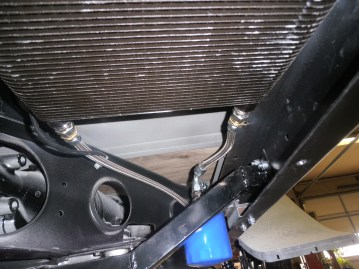
We don’t often consider what is underneath a car or that the real estate down there could get crowded. In fact there is a lot going on out of sight and often it isn’t pretty. But I have always wanted my cars to look good even when put up on a hoist and seen from below–a vantage point that is generally ignored in all but the most expensive builds. I don’t have enough money and hopefully too much common sense to order everything chrome plated. But I do like order, harmony, and good engineering.
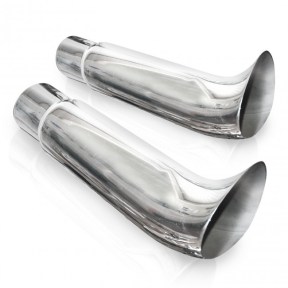
In addition to the exhaust system, there are frame rails to be considered. You don’t want much hanging below the frame. That would be an invitation to disaster. So what we are talking about here is about a six inch slice. The battery is there, brake lines are there including those for the emergency brake, and various steering and suspension bits. In the case of this car there are really four exhaust pipes, two splitting off from each engine bank. One set of pipes has a muffler and the other is open. The exhaust is routed one way or the other through an electro-mechanical server controlled by a switch inside the cab. For a lot more noise and a little more power, I can choose the open pipes. To please my next door neighbors, I can choose to have the hot exhaust gases flow through a set of mufflers.
Mufflers, tube type and diameter, x pipe, cutouts
 Don Holsinger--an old guy's street rod