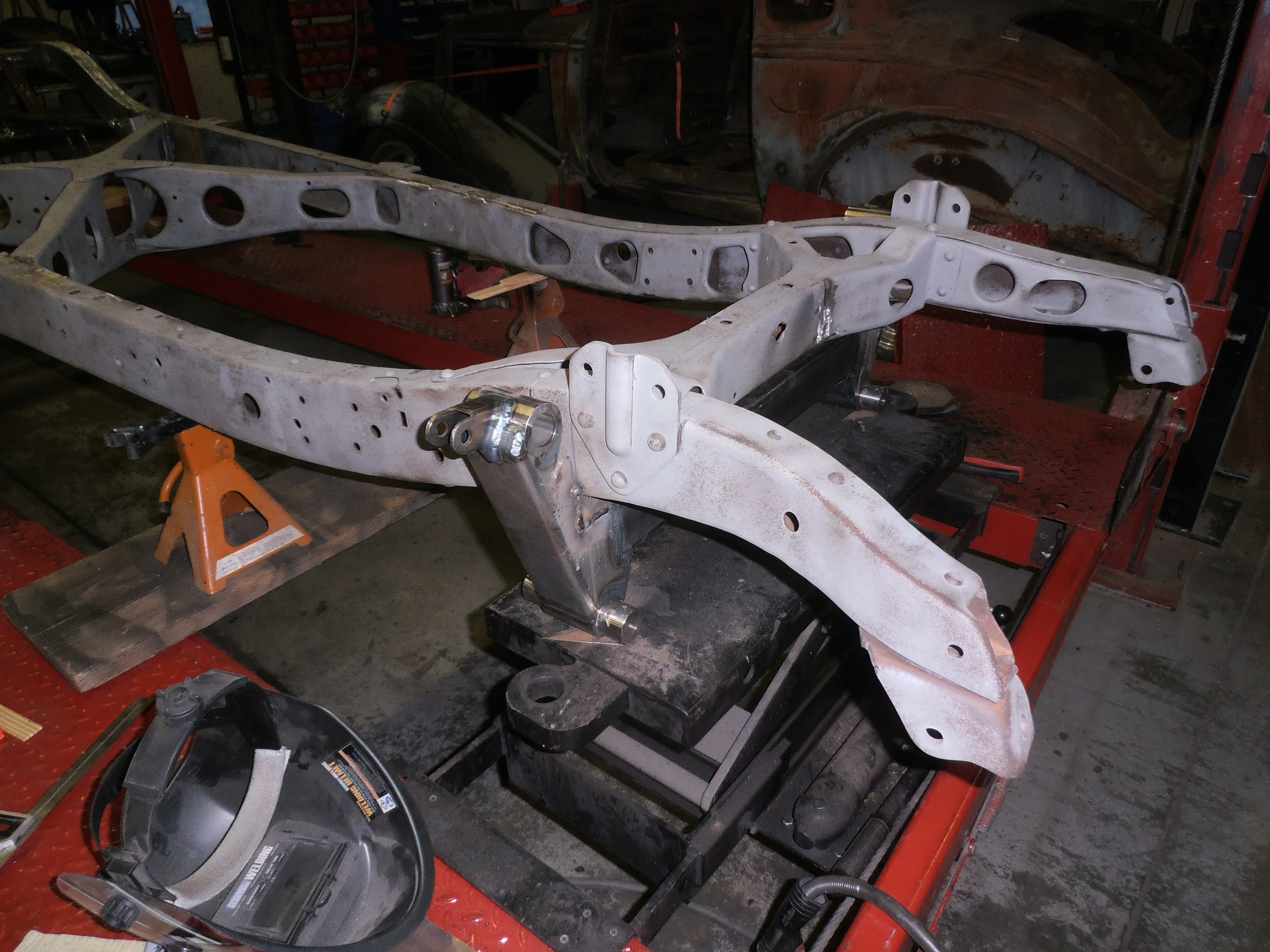
One thing depends on another. Although isn’t a set sequence to rebuilding a car some jobs clearly must precede or follow others. For example, the engine placement is critical but it must be set onto the frame such that the carburetor is level with the ground. But how would you know what is level with the ground if the frame isn’t straight with, the suspension bits in place? Street rods of all sorts typically have “bigs” and “littles”. The tall tires and wheels are in the rear and the shorter ones up front. Don’t ask me why they just do. Almost always. If those tires aren’t on the vehicle how could you determine level? And there are many other examples.
The frame was sandblasted. Then it was checked every which way to be true and straight. All welds were examined. New welding of questionable joints. Then the frame was boxed. Originally almost all frames for vehicles were “C” channels—actually more like this “[“. By boxing is meant the addition of steel on the open side forming a closed rectangular shape. Heavier but much stronger and given the age of the old frame and the new duties to be asked of it, better to have the stronger, more rigid frame. After all the preparation work the frame is carefully painted with a rust inhibiting paint.
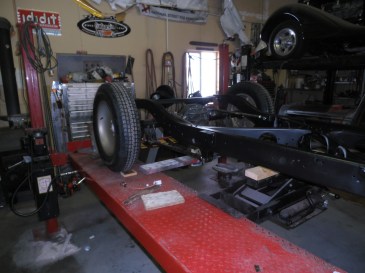 Now we ready for the suspension.
Think of suspenders. What do they do? As a dedicated suspender wearer, I understand that the critical function is to keep my pants up. Suspensions systems do that and a little more. The suspension makes for a pleasant, smooth ride. Keeps the car pointed in the right direction and keeps the whole frame and body and everything inside from dragging on the pavement.
The original suspension just wouldn’t work here. It was a straight steel beam in the front. This is the way it had been done almost from the beginning of automotive history. A straight iron axle with wheels on each end and a pair of leaf springs bolted to the axle in the center and to the frame at each. Well who wants to know this anyway? Let’s be brief.
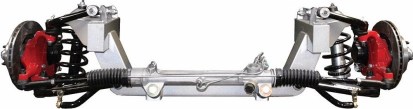
The image to the right is what you get from Kugel out of the box. Not that brakes and coil over shock absorbers are included as is the steering arm. We will have electric power steering in the old Dodge.
In the rear, it was much the same although more fabrication is required. The rear axle has several additional functions and one less–it doesn’t steer the vehicle. But it is the part of the suspension system responsible for sending power from the engine to turn the rear wheels. Like the front, the rear axle originally had another pair of leaf springs holding up the frame.
 None of the suspension works well for a vehicle with triple the horsepower of the original and with speeds that are at least double those of 1935.
 The entire suspension system is now new on the ’35 Dodge. It is all painted, and can actually roll around the shop floor. For the front suspension, we used a suspension system from Kugel. They’ve been around a long time. Ralph sends the exact measurements of the frame and other details and they send a kit with parts that bolt on. Some things are welded for safety. Everything is there, breaks, springs, shock absorbers, steering. It saves tons of time, and the ride will be smooth and safe.
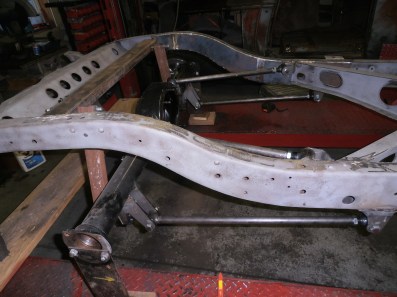
In the rear, the suspension is still a straight axle but we use a system called triangulated four bar. It looks like this:
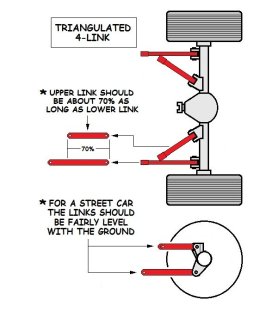 The pieces come in a box and Ralph welds the several bits to the rear axle housing. Not shown are the very cool coil over shock absorbers.
 Don Holsinger--an old guy's street rod