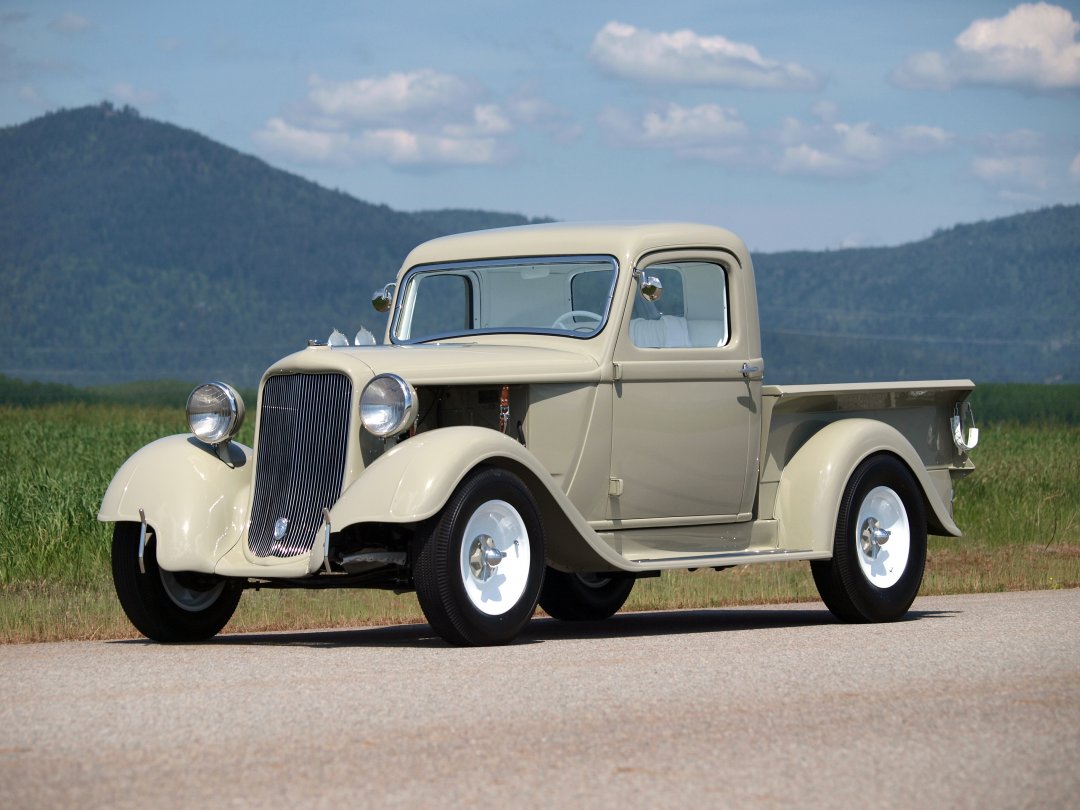
The mind’s eye…you have to be able to see your street rod, visualize it in some detail and then capture it on paper to share with your more talented others. The image above of a gorgeous 1935 Dodge, not mine, is close to my conception of what we are making here. It won’t be a perfect replica of this rod, will have a different color, different engine and interior. But this is as close to what mine will become as I have ever seen. Goes to show you that very few things we imagine are totally unique. If you have thought of it, no doubt someone else also has.
The general wisdom on “how to build a street rod” is that before outlaying a lot of cash for a car or on parts, you should have a good idea, a plan, of what kind of street rod you want to build. The variations are enormous. If not a “firm” idea you will need at least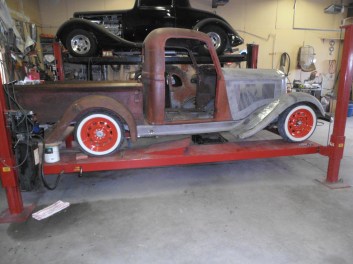 a “good” and doable and affordable idea. You should be able to see the car in your mind’s eye down to some pretty fine detail.
That’s not hard for me. My role here is akin to that of an architect. And I’ve been doing this for a very long time. My mind’s eye is often better than my natural ones. That particular quality can be problematic when it may result in cost overruns. Other advice includes:
- Does your imagined street rod fit you?
- Can you afford this—set a realistic budget?
- How much of the work will you do yourself?
- Set up a long-term time frame and be realistic.
- Stick with your plan.
- Spend more money to get a better car to start with.
- Do the chassis first and the body second or it won’t fit right.
- Locations of engine, transmission, pedals and radiator have to be fixed early on.
- Pre-assemble the whole thing before painting.
- If you want your wife to like the car insulate it.
- Put the new wiring in before you paint.
- Have fun!
- (Don’t expect all your friends to like your plan)
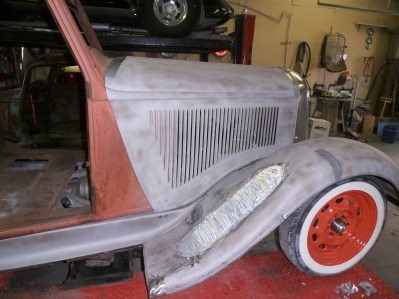
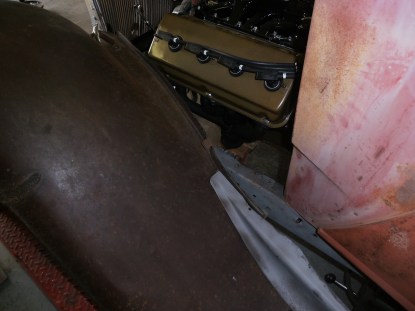
None of this was either new or frightening to me when I acquired the 1935 Dodge pickup in November of 2015. I had been through the process at least five times before and with the same principal builder. Still I prepared a ten-page build plan and discussed it carefully with Ralph. We discussed, shared perspectives, used persuasion, and in the end agreed.
Ralph, about whom I’ll have more details to add later, of course has his own way of doing things. I play the roles of owner, visionary, architect and banker and Ralph is the chief technical officer, master metal shaper, welder, mechanic, photographer, reality checker and bearer of both good and bad news.
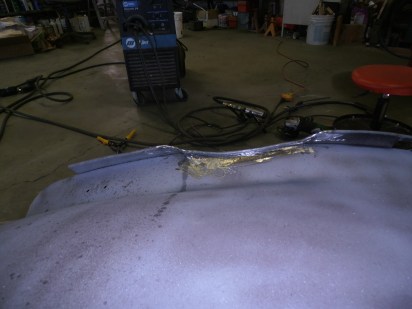
There are a couple of photos here of the left front fender. I knew what engine I wanted in this street rod and I wouldn’t change that requirement. But I could not foresee beforehand that the engine would interfere with a portion of the fender. The result is that the fender had to be modified slightly. This sort of total advance planning isn’t possible with a Dodge. If I were building a ’32 Ford that would be different. That car has been built so many times that a voluminous literature, if consulted, removes all guesswork and surprises.
I am not going to paste my project build plan here—way too long and complicated. It is probably 20 pages, has dozens of photographs and illustrations, and names and addresses of parts suppliers.
Stick with your plan. I sort of do that but details evolve, the vision changes slightly, new products come available, unforeseen obstacles arise, things imagined in the mind’s eye occasionally don’t fit well in real world eyes.
Tomorrow: “Building a hemi engine!” Wow is it expensive! But it is really fun.
 Don Holsinger--an old guy's street rod